
Johor . NS . Selangor
News
Johor-Singapore SEZ’s RM68 billion fuels state’s record investment haul as interest swells
By Tan Ai Leng January 26, 2026
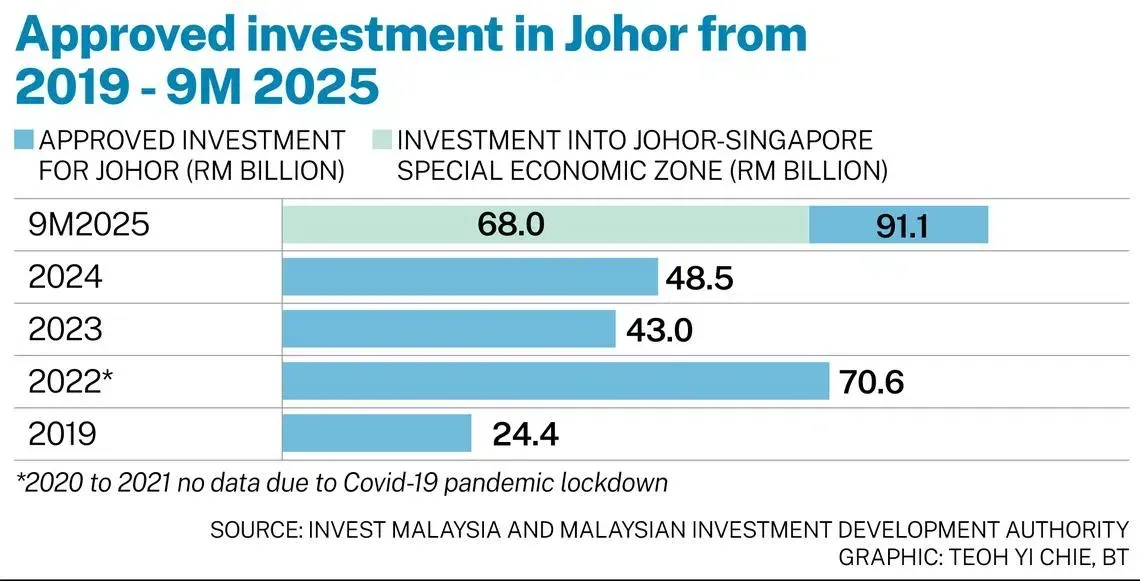
[KUALA LUMPUR] The Johor-Singapore Special Economic Zone (JS-SEZ) pact locked in RM68 billion (S$21.9 billion) in approved investments during the first nine months of 2025, accounting for nearly 75 per cent of Johor’s record RM91.1 billion, one of the country’s top officials told The Business Times.
This marks a staggering leap from the RM48.5 billion in approved investments recorded for the whole of 2024.
Active enquiries totalled RM73 billion in 9M 2025, signalling that the zone is outpacing initial expectations and cementing its role as one of Malaysia’s powerhouses for growth and foreign direct investment.
Newly minted Economy Minister Akmal Nasrullah Mohd Nasir, however, said the headline numbers tell only part of the story. The harder test is how fast the authorities can turn approvals into projects, and plans into execution.
“Planning worked and now 2026 is about delivery,” he told BT in an exclusive interview in Putrajaya. “The question is how quickly approved investments translate into real activity on the ground.”
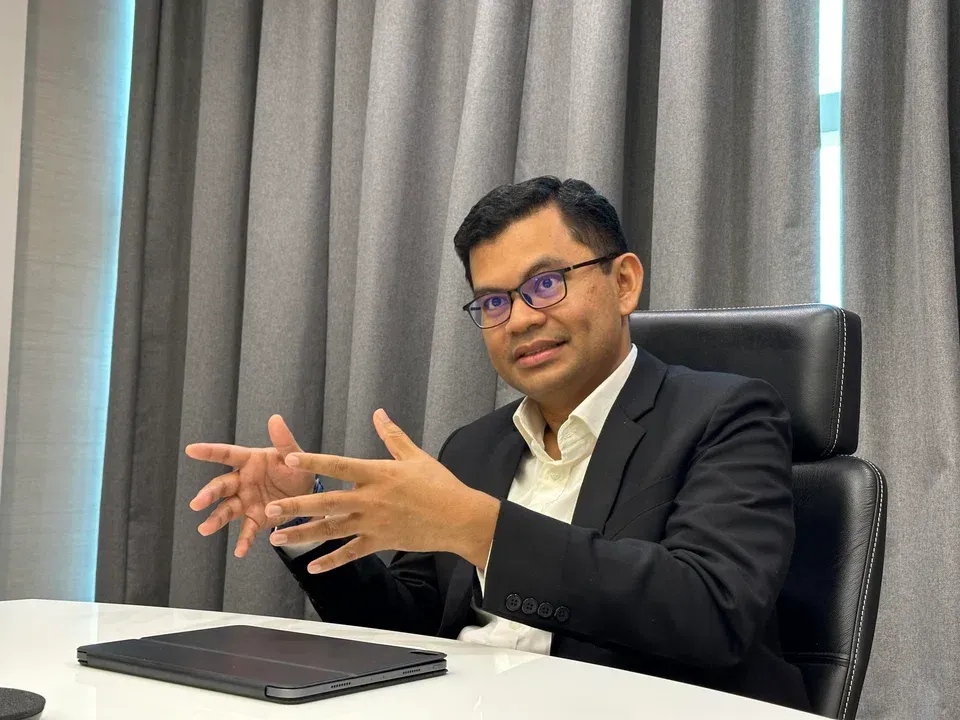
The 39-year-old economics and actuarial science graduate from the University of Wisconsin-Madison in the US is the second-youngest minister in Prime Minister Anwar Ibrahim’s Cabinet after a reshuffle on Dec 16, 2025.
He replaced Rafizi Ramli, who resigned in 2025, and stepped into a key portfolio that shapes everything from national growth and productivity to jobs, wages and long-term competitiveness.
Prior to this, Akmal served as deputy minister for local government development and deputy minister for energy transition and water transformation, roles that provided a strong grounding in technical execution.
“In the Economy Ministry, you cannot be good at only one thing,” he said. “You need to understand the whole system – and how policies actually get implemented.”
Having been in his current office for just over a month, Akmal said developments are moving rapidly as the government prepares to present the nation’s economic focus and direction for 2026 at the Malaysia Economic Forum on Feb 5.
The minister said these announcements will include further updates on the JS-SEZ. The next major milestone for the zone is its blueprint, expected to be unveiled in the first quarter of 2026.
While many are anticipating more details on incentives, Akmal noted that the crucial part of the blueprint document is designed to fix the bottlenecks that slowed the execution.
“It is about streamlining processes, integrating agencies and clarifying roles,” he added. “Investors want certainty, speed and predictability. They do not want complexity.”
Tackling pain points
While the Invest Malaysia Facilitation Service Centre Johor has been established to interface with investors as a one-stop centre, Akmal acknowledged that real friction often arises behind the scenes: in overlapping approvals, unclear timelines and fragmented coordination between federal and state agencies.
“That is where the blueprint comes in. It will sharpen sector priorities, align implementation responsibilities and clarify what types of investments Malaysia wants the zone to attract,” he said, noting that the priority is not just in value terms, but in productivity and spillover potential.
“It is not only about bringing investment… It is about increasing productivity and the quality of outcomes,” said Akmal, who was appointed and sworn in on Dec 17, 2025.
Investors, SMEs and spillover effects
Big-name multinationals (MNCs) often dominate attention around special economic zones, but Akmal is keen to ensure that small and medium-sized enterprises (SMEs) are not left behind.
“It’s not just about the big names,” he said. “Large investors play an important anchoring role, signalling confidence and drawing others into the ecosystem. But the zone’s long-term success depends on whether SMEs benefit through supply chains, services and partnerships.”
Akmal said about 1,000 enquiries from SMEs have been recorded, including interest from Malaysian, Johor-based and Singaporean SMEs.
Some worry that heightened competition could squeeze margins, but Akmal argued that competition, if managed well, can raise productivity across the board.
“Healthy competition can benefit everyone. The key is spillover where SMEs can become part of the value chain, not just spectators,” he said, adding that the ecosystem built by MNCs and SMEs will be critical in ensuring the zone delivers not just capital inflows, but also sustainable economic upgrading.
Johor’s semiconductor ambition
One of the most ambitious narratives around the JS-SEZ is Johor’s emerging role as Malaysia’s third semiconductor hub, alongside Penang and the Klang Valley.
Akmal linked this potential to Johor’s recent success in attracting data centres, which underpin digital infrastructure, artificial intelligence and advanced manufacturing.
These investments, he noted, lay the foundation for higher-value digital and advanced manufacturing activities that can generate more high-quality jobs for Malaysians. This is a priority for Akmal, who is also the member of parliament for Johor Bahru.
“Even so, we are building ecosystems around 11 priority sectors, not chasing isolated projects… The idea is not to single out one or two sectors,” he said.
Akmal stressed that the authorities are looking at how investments or specific projects can complement different industries and reinforce one another.
For instance, the Southern Agropolis development in Sedenak – a joint venture between Singapore-based Archisen and government-linked Southern Catalyst – will create an agrifood hub that integrates farming, agritech and foodtech, food processing and logistics activities.
Against this backdrop of rising data-centre and semiconductor-related investments, Akmal sees Johor’s trajectory as being aligned with Malaysia’s push to move up the value chain beyond packaging and testing into design, chip fabrication and other higher-value activities.
Consistency over speed
Akmal stressed that the primary lesson for Malaysia is not speed, but consistency. “Policy continuity, institutional stability and sustained investment matter far more than quick wins,” he said.
He highlighted that Johor possesses the structural foundations to support this long-term ambition: abundant land, competitive business costs and an existing industrial base, all anchored by its proximity to Singapore and a burgeoning pool of young talent.
“With steadfast consistency, it is not far-fetched for the zone to emerge as a major regional growth centre over time.”
COMPANY
TopHills Realty (M) Sdn. Bhd. 201301010493 (1040335-X)
E(1)1465
0528 & 0529, Indah Walk 3, Jalan Indah 15, Taman Bukit Indah, 79100 Iskandar Puteri, Johor
QUICK LINKS
Copyright 2026 Industrial Malaysia All Rights Reserved.
